

The recently released 15th Five-Year Plan for Yunnan Province outlines the direction for infrastructure development over the next five years. In the section on railway construction, the plan only states: “We will orderly advance the construction of the Southwest Border Railway, including the Wenshan to Jingxi and Pu’er to Lincang sections, and push forward the Dali-Lijiang-Panzhihua Railway.” Notably, no new high-speed rail or intercity rail projects are mentioned at all.
This marks a stark contrast to the 14th Five-Year Plan, which envisioned a network of high-speed and intercity railways across the province. In the 15th Five-Year Plan, these high-speed projects have completely disappeared from the agenda.
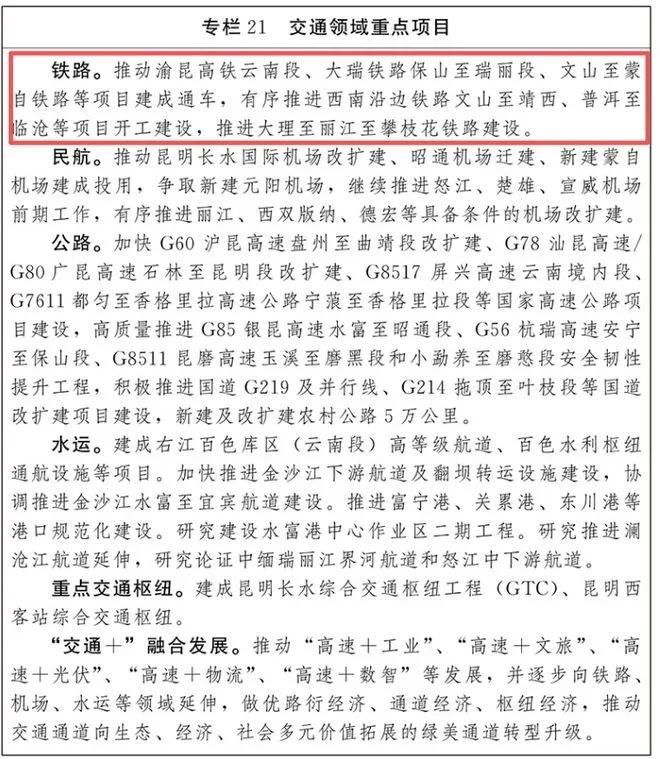
According to the “Yunnan Province 15th Five-Year Railway Planning Diagram” released alongside the plan, all planned lines are conventional-speed railways. Projects such as the Central Yunnan Intercity Railway, Kunming-Chuxiong-Dali High-Speed Railway, and the Yunnan section of the Shenzhen-Nanning-Kunming High-Speed Railway are no longer included.
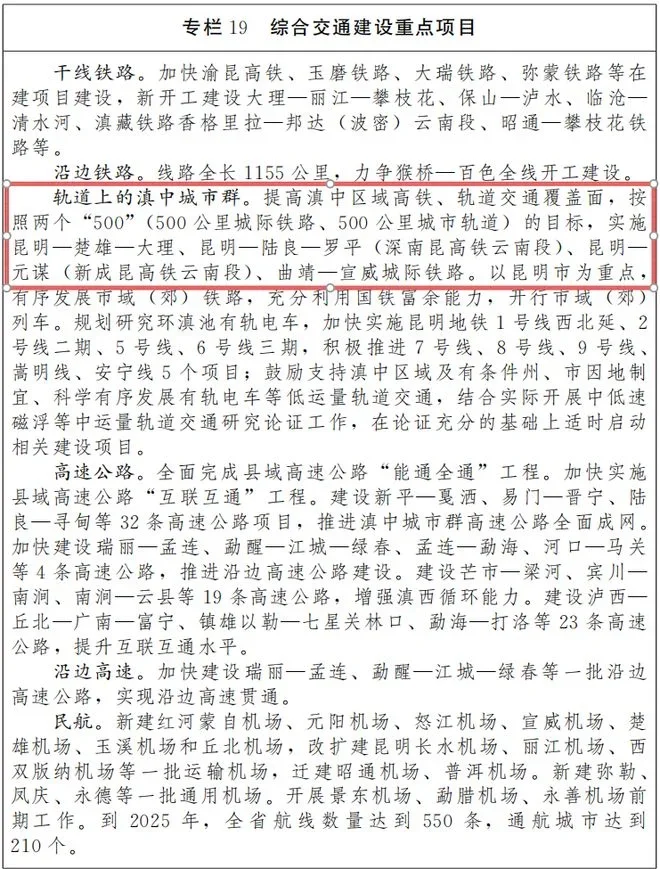
Under the 14th Five-Year Plan, Yunnan had proposed starting construction on the Dali-Lijiang-Panzhihua Railway, as well as advancing several high-speed rail projects, including Kunming-Chuxiong-Dali, Kunming-Luliang-Luoping (the Yunnan section of the Shenzhen-Nanning-Kunming line), Kunming-Yuanmou (the Yunnan section of the new Chengdu-Kunming line), and the Qujing-Xuanwei Intercity Railway. The Central Yunnan Intercity Railway was even listed among the province’s top ten new infrastructure projects.
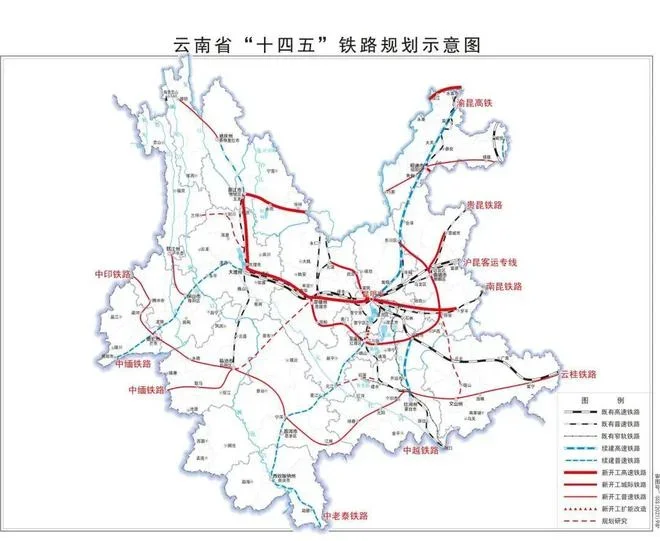
The 14th Five-Year railway plan diagram also included a high-speed rail line passing through Shuifu and Suijiang in Zhaotong City (likely the Yibin-Xichang-Panzhihua High-Speed Railway, which local governments had long pushed for). However, in the new 15th Five-Year plan, this line has been dropped entirely.
The most significant example of the shift is the Dali-Lijiang-Panzhihua Railway. In the 15th Five-Year diagram, the entire line is marked as a planned conventional-speed railway. Just last year, preliminary work tenders for the project indicated that the Dali-Lijiang section would be built as a 250 km/h high-speed railway, while the Lijiang-Panzhihua section would be a mixed passenger-freight conventional line. But the national 15th Five-Year Plan, released earlier this year, also categorizes the entire line as a conventional-speed railway, signaling a downgrade from earlier ambitions.
The disappearance of high-speed and intercity rail plans is not entirely surprising, given central government policies. In 2021, China issued guidelines to strictly control high-speed rail construction, mandating that underdeveloped areas in the central and western regions should use conventional-speed standards unless they meet strict passenger density thresholds. This has led to a reassessment of projects like the Dali-Lijiang-Panzhihua line.
As for the Central Yunnan Intercity Railway, it faced obstacles from local debt pressures and stricter approval requirements for intercity rail projects introduced in recent years. The Yibin-Xichang-Panzhihua High-Speed Railway has also been shelved, partly because Sichuan Province now prefers a route that stays entirely within its own borders, bypassing Yunnan.
The shift away from high-speed rail reflects a fundamental change in Yunnan’s railway development philosophy, moving from a focus on speed to one on practical utility. Over the next five years, conventional-speed railways will be the primary means of expanding the network. For the Central Yunnan urban agglomeration, while the dream of a high-speed intercity network may be fading, ongoing projects like the Chongqing-Kunming High-Speed Railway and the Dali-Ruili Railway, combined with new conventional lines, will still improve regional connectivity.
